


This dispatch is part of From the Window Seat, a series of immersive, long-form personal trip reflections, in-depth destination pieces, and sharp hospitality evaluations grounded in firsthand reporting and personal experience.
Ed. note: Flights and accommodations for this trip were provided by Alaska Airlines. As always, I only share experiences that I genuinely love, and all opinions and recommendations are entirely my own.

The feeling of standing atop a sprawling glacier streaked with black volcanic ash, floating through pure glacial water between two tectonic plates, the distinct profundity of witnessing the sky turn black and then bright again, as if someone simply flipped a switch—there is really only one way I can describe the experiences I had in Iceland, and that is pure and utter awe.
Dacher Keltner, one of the world’s leading experts on the science of human emotion, defines awe as the sensation of encountering something so vast that it transcends your understanding of the world. Neurologically, it actually silences our ego and overthinking, replacing it with the “small self” effect: self-importance diminishes, your day-to-day worries disappear, and you feel profoundly connected to the world around you—suddenly aware of how truly small you are within it.
Before this trip, I was aware of the concept of awe; loosely knew its definition as a word. But I don’t think I had ever really experienced it so viscerally. What started as a quick long-weekend getaway quickly turned into a masterclass in letting go of control and learning an essential, grounding truth: being small in a vast world isn't terrifying. It's absolute freedom.
Read on for:
The non-negotiable layering system you need for Iceland's summer weather
The ultimate arrival ritual to reset your circadian clock before your trip even begins
How to cover the South Coast’s most dramatic landscapes in a single day—without renting a car
What it feels like to snorkel in 35°F glacial meltwater

The reason I went to Iceland was to experience Alaska Airlines’ seasonal route connecting Seattle-Tacoma International Airport (SEA) directly to Reykjavík’s Keflavík International Airport (KEF), perfectly timed for the solar eclipse, as Reykjavík was in the path of totality.


The most interesting thing about this specific route is that it represents the longest nonstop flight operated by a US carrier on a 737. If you’re like, wait: isn’t that a single-aisle plane that you’re flying for seven-ish hours in? The answer is yes. And I understand the impulse to find that concerning; from a passenger perspective, it does sound counterintuitive using a smaller plane for a longer international route. But just know that what you lose in space you make up for in more efficient boarding and de-planing processes.
Another interesting aspect of the Alaska in-flight experience: you won’t find any seatback screens. This was actually more surprising to me than using a narrowbody for a transatlantic long-haul route, and I’ll admit: at first I found it confusing. But after some research, I began to understand the decision. Seatback screens are costly to install; they add weight to an aircraft, and if they don’t work, you’ll have some really angry customers. That’s a lot of variability for entertainment when 99% of today’s passengers travel with at least one source of entertainment themselves, usually right in their own pocket. To compensate, Alaska does its part to help you out: there are built-in seatback clips to hold your phone or tablet at eye level, and every seat has fast-charging USB-C ports to keep your tech juiced up. Add Starlink Wi-Fi to the mix, and a robust library of over 1,000 free movies and TV shows streamed right to your browser, and I bet you’ll forget anything was ever missing.
As for what the cabin experiences were like, I got a complete sampling over the course of the four individual legs of my journey:
Domestic First (SEA<>EWR): Spacious recliner seats with cozy Filson blankets, a generous 41” seat pitch, and a footrest (Alaska’s newest 737 MAX 8s and retrofitted 738s also have a calf rest). With this ticket, you can also access the gorgeous flagship Alaska Lounge in Terminal N, which is well worth the quick train ride even if your flight departs from another concourse.
Premium Class (SEA>KEF): Premium Class (rows 6–10) gets you the exact same seat as Main Cabin, but bumps the pitch up 4-5 inches, which, on a 7-hour flight, is make-or-break for your ability to work comfortably on a laptop or sleep without your knees jamming into the seat in front of you. Extra perks here: complimentary alcoholic beverages and priority boarding.
Main Cabin (KEF>SEA): My favorite feature here: unlike older airplanes where USB ports barely charge a phone, Alaska’s MAX 8 Main Cabin features fast-charging USB-C ports alongside 110V AC outlets.


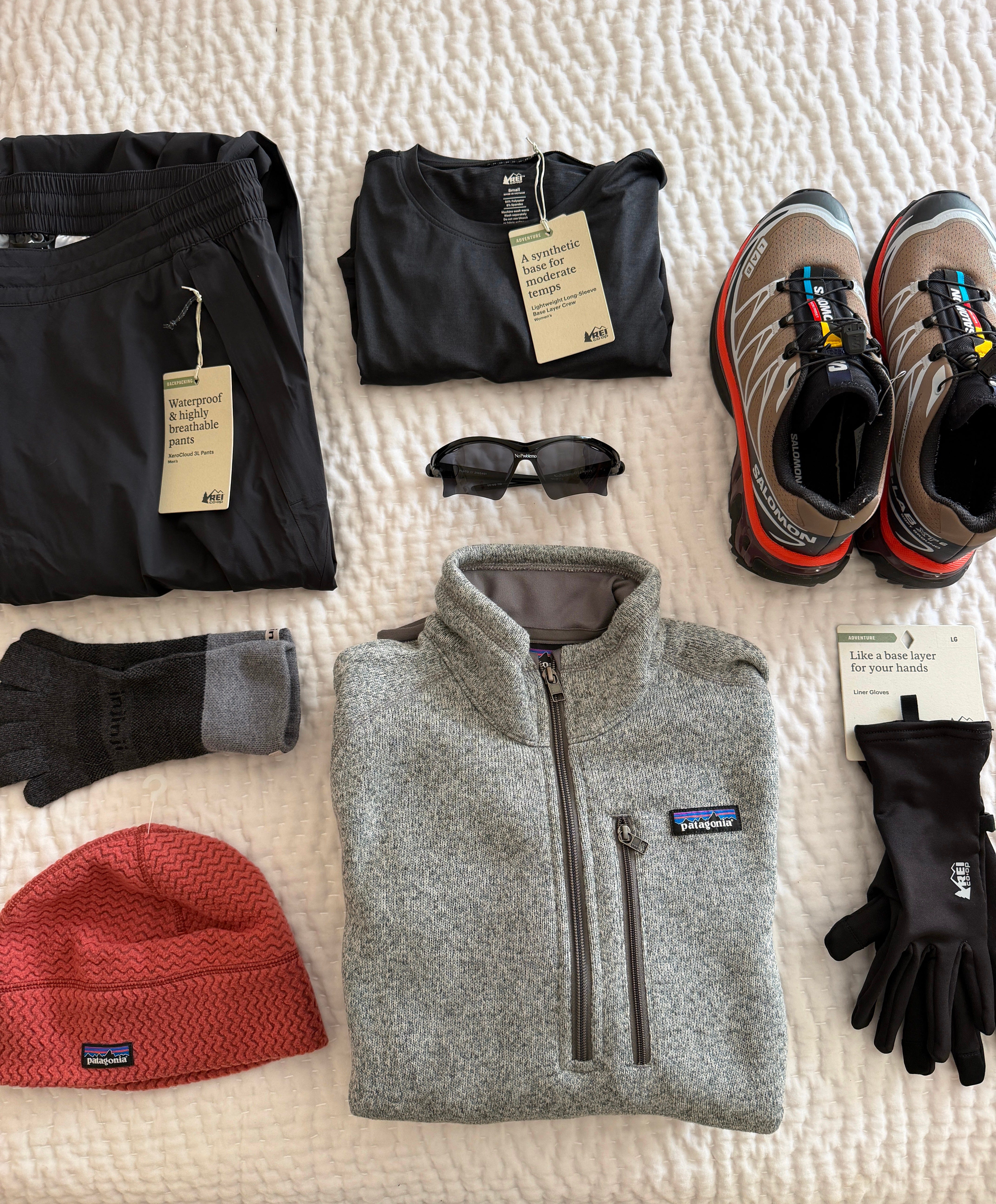
Iceland is NOT one of those trips where you just throw a bunch of clothes into a suitcase. It is a place that demands a specific, intentional packing list. Even if you don’t partake in any adventurous hiking or excursions (in which case, I ask: why are you even going??), the weather is its own kind of unpredictable beast that you need to be prepared for or you’re gonna have a Bad Time.
The weather was the thing I couldn’t quite wrap my head around until I got there. My trip was in early August, and the forecast was calling for rain and temps in the mid-50s and 60s. It was the height of summer, yet I found myself packing winter gloves, hats, thermal underwear, and fleece layers for the brutal wind I’d heard so much about in my pre-trip research. I kept thinking I would be so hot—no way would I need all those layers with the sun so high in the sky and the activity level I’d have, right? Dear reader, heed my warning: pack the layers.
Here’s my complete packing list:
Technical clothing
You need a waterproof jacket, no exceptions. Not water-resistant. This is your single most important piece of gear. Mine was an absolute lifesaver against the whipping wind and waterfall spray. This is a piece worth investing in! To that end, waterproof pants are just as essential as the jacket. Otherwise, you WILL be walking around soaking wet. Finally, sturdy hiking boots are a nice-to-have, not an essential, as you can rent boots at a lot of the activities that require this footwear. Otherwise, bring a hiking shoe (preferably Gore-Tex).
I’d also recommend getting a comfortable 20L–30L backpack. I’m recommending something at least this big because you’ll need space to carry any extra layers you want to bring or shed. Plus snacks for long outings, your camera gear, portable charger, etc.
How to layer appropriately
Dressing in layers is the key to surviving and thriving during your trip here. You need three layers: a base layer, a mid layer, and your shell (the waterproof jacket we covered above). The base layer is the most important part of this equation, as it sits closest to your skin. It needs to be moisture-wicking, so the material is extremely important: make sure yours is merino wool or a synthetic material. I packed this lightweight long sleeve. The next layer is your mid layer, which can be some kind of sweater or fleece—something that insulates. For mine, I packed a quarter-zip fleece.
Additional clothing
Regardless of the time of year or the weather, pack a swimsuit and some flip-flops so you can enjoy one of Iceland’s many geothermal lagoons. It’s a must-do.
Tech & accessories
If ever you’re going to invest in a camera that isn’t your phone, this is the time. I had my film camera and my DJI Osmo Pocket 3 with me on every outing. I’d also get a waterproof phone pouch so you can bring it into the lagoons without worrying.
I’m a water snob, so you can take it from me: Iceland has the purest, crispest drinking water on Earth. Pack a reusable water bottle so you can bring some home. It’s that good.
The sun doesn’t set until reeeeeally late in Iceland (midnight sun is a thing here, too, during the summer), so you need an eye mask for sleeping whether you normally wear one or not. To that end, bring sunglasses. I’d recommend getting a pair specifically for hiking that's a bit more protective and supportive.
Iceland uses European-standard plugs, so bring a plug adapter.
